
Stationery has always been more than just paper and ink. It’s a record of thoughts, communication, memories, and creations. Long before notebooks lined our shelves and letters were folded and sent in envelopes, people were experimenting with materials and tools to physically hold these records. In this post we will explore the history of stationery and its current relevance.
Earliest Materials
Some of the earliest known stationery tools came from ancient Egypt. Around 3000 BCE, Egyptians developed papyrus, a writing surface made from the papyrus plant that grew abundantly along the Nile River.
Papyrus was created by slicing the plant’s stalk into thin strips, layering them in a crisscross pattern, pressing them together, and drying them in the sun. The natural sugars in the plant acted as a glue, binding the strips into a smooth flexible sheet that could be used for writing. These sheets were often joined end-to-end to form scrolls, making papyrus one of the first mass-produced writing surfaces.
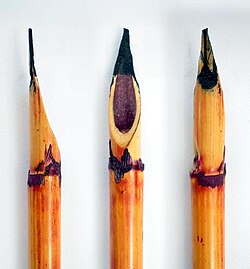
To write on papyrus, Egyptians used pens created from reeds by cutting the tip of a reed into a point or split nib (much like the tip of a fountain pen). Ink was made from soot mixed with water and a binding agent, like gum arabic/acacia gum, an edible resin from the hardened sap of Acacia senegal and Acacia seyal trees. Writing was more than just written communication, hieroglyphs and hieratic scripts were also a visual art.
Papyrus documents recorded everything from religious texts and government records to personal letters and shopping lists, showing that even in ancient times, stationery played an important role in daily life.
Paper Shifts
Around 105 CE, Cai Lun (Eastern Han Dynasty Chinese court eunuch) is traditionally credited with standardizing the process of paper making.
Early Chinese paper was made from a mixture of rags, hemp, bamboo, and tree bark. These materials were soaked, ground to pulp, and suspended in water. A screen mold was dipped into the mixture, allowing water to drain away and leaving behind a thin mat of fibers that dried into paper. This is a practice still used to make paper today (we will get to that below).
Compared to papyrus paper was more affordable, more flexible, and easier to produce in large quantities. This transformed literacy, record-keeping, and art.
Paper making techniques gradually spread along trade routes into the Islamic world and later into Europe, where they would eventually replace parchment and vellum for many everyday uses.
Monks and Paper
In medieval Europe, before paper became widely available, books and documents were often created on vellum or parchment, both made from animal skins (usually calf, sheep, or goat skins).
Monks working in monasteries were among the most skilled stationers of their time. In scriptoriums (a dedicated room in medieval European monasteries used by monks and scribes to hand-copy, illuminate, and produce manuscripts) they carefully prepared vellum by stretching, scraping, and polishing the skins to create a smooth writing surface. These manuscripts were labor-intensive and precious. A single book could require the skins of dozens of animals and be costly.
Writing instruments also evolved in medieval Europe. Quill pens made from large bird feathers (often goose or swan feathers) became the standard writing tool. The feather’s hollow shaft allowed it to hold ink, while the nib could be cut and reshaped as needed.
Many medieval manuscripts were decorated with hand-painted illustrations, elaborate borders, and gold leaf called illuminations. These works combined stationery and fine art.
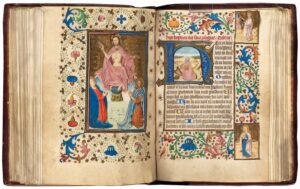 Medieval European manuscript, the Book of Hours, featuring illuminations and illustrations
Stationers’ Shops and the Term “Stationery”
As literacy expanded with the increased availability of an affordable writing material, so did the need for specialized goods and services. By the late Middle Ages, stationers’ shops began to appear across Europe.
Originally, stationers often acted as publishers, bookbinders, scribes, and suppliers of ink, parchment, and writing tools. In some cities, stationers controlled the production and sale of books, renting manuscripts to be copied by hand.
These shops became hubs of intellectual life where scholars, students, and writers gathered. They were often found in areas near to universities. The word “stationery” itself is believed to come from these fixed “stations” or shops.
The Printing Press
One of the most significant and pivotal moments in stationery history came in the mid-15th century with the invention of the printing press by Johannes Gutenberg.
Gutenberg’s movable type press, developed around 1440, allowed text to be reproduced quickly and consistently. This innovation dramatically reduced the cost of books and written materials, making them accessible to a much wider audience. While the original Gutenberg press has been lost to history, some of these style printing presses are still used today in museums and niche shops. The International Printing Museum in California has a replica of the Gutenberg press as well as other letter presses in working condition.
The printing press changed not only how information spread, but also how stationery was used. Printed books, pamphlets, and forms increased demand for paper, standardized layouts, and consistent typefaces. Writing was no longer limited to elites or religious institutions and became part of everyday life.
Stationers adapted, shifting from hand-copying texts to selling printed materials, blank paper, notebooks, and correspondence supplies. Around this same time the wealthy began to seek out paper adorned with intricate watermarks and personalized seals for their communications.
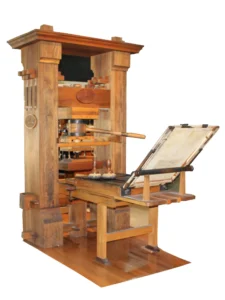 Replica of Johannes Gutenberg’s print press
How Paper Is Made Today
Although the tools and scale have changed dramatically, modern paper making still follows the same basic principles developed thousands of years ago by breaking plant fibers down and reforming them into sheets.
Most paper today is made from wood pulp, sourced from trees such as pine, spruce, and eucalyptus. These trees are chosen for their long, strong fibers, which help create durable paper suitable for writing, printing, and art. Recently, paper is also made from recycled materials, using post-consumer waste like old notebooks, office paper, and cardboard offering a more eco-friendly option.
Along with mechanically breaking wood fibers down to create paper, chemical methods are also used. Chemical pulping removes lignin (the natural substance that binds wood fibers together) resulting in stronger, longer lasting paper commonly used for stationery and books.
The pulp is then mixed with water and spread onto a moving screen in a large paper making machine, much like the process used by Cai Lun. As the water drains away, the fibers naturally interlock, forming a continuous sheet of paper. This sheet passes through rollers to press out excess water, then through heated dryers until it is fully dry.
In the final stage, paper is finished based on its intended use. It may be smoothed, textured, coated, or cut into sheets, rolls, or pads. This is where differences in weight, surface, and quality become apparent and refined.
From Then to Now
The stationery we use today carries the legacy of thousands of years of experimentation and craftsmanship. Each sheet of paper connects us to papyrus makers along the Nile, paper makers in ancient China, monks hunched over vellum manuscripts in Medieval Europe, and printers operating hand cranked presses. Understanding this history reminds us that stationery is not insignificant. It is an important piece of ever expanding history that continues to shape how we tell stories, record memories, and connect with one another.
The Return to Analog
With the rise of the digital world and constant information overload there has been a shift back towards analog media. People have returned to journaling with paper and pen rather than a digital diary and paper planners are making a big resurgence.
Stationery has become a once again sought out product for people to add to their daily lives and you see more places beginning to carry notebooks and pens once again. While the return to analog to escape the digital world has boosted stationery back into the limelight, so has digital media.
Social media with short form videos and long form videos has helped to broaden the ideas of what stationery can be used for. Currently there is a growing set of people looking to create a personal curriculum, a self paced and designed guide for learning a topic. Bullet journalling has also become a sizable movement, combining journaling with task tracking and project management. Stationery has become a very popular product of small businesses and artists as well – everything from stickers, to paper pads, to notebooks and more.
I personally love, and have always loved, paper and pens. I have always had an extensive collection of both and so did my mom. We would spend so much time browsing the aisles of stores looking at all of the different pens and notebooks. Its a cherished memory.
What role has stationery played in your life?